Search

When Effort Becomes the Risk

Most businesses don’t struggle because people aren’t trying hard enough.

In most cases, the opposite is true. People are trying exceptionally hard, often harder than they should have to.

That effort is usually what keeps the business functioning. It fills the gaps in systems, absorbs variation, and protects customers when processes don’t quite hold.

The risk appears when that effort becomes the strategy.

When performance depends on people stepping in, stretching, and compensating every day, the results may still look fine. Targets may even be hit.

But the business isn’t really carrying that performance. The people are.

That kind of performance is fragile. It relies on personal bandwidth and informal fixes rather than on capability the organisation actually owns. Over time, pressure concentrates and dependency grows.

This creates a ceiling that is impossible to break, especially as the business grows. At scale, reliance on extraordinary effort doesn’t just exhaust people; it makes value harder and harder to sustain.

Strong businesses don’t eliminate effort, they respect it, but they don’t build the foundation on it.

They design systems that can carry performance reliably, so results don’t hinge on who happens to be available or willing to absorb the strain.

The goal isn’t to reduce the good kind of effort, the creativity, the problem-solving, the care.

It’s to stop relying on it to compensate for gaps in operational capability and maturity the organisation has not built.

January Plans Don’t Fail for Lack of Ambition

January plans rarely fail because the targets are wrong.

They fail because they assume the system has changed, simply because the calendar has.

By mid-January, many leadership teams are already feeling the gap between what the plan assumes and how the business is actually behaving.

The plan is underway.
Targets are clear.
But the pressure hasn’t eased.

Decisions still escalate.
Issues return faster than expected.
Complexity is still being absorbed by individual heroics rather than by systems designed to carry it reliably.

The dashboard looks green, reassuring on the surface, while underneath the system is already over-leveraged and compensating for things the plan never addressed.

Most January plans are built around intent: growth, revenue, priorities.

What they depend on is behaviour: how decisions are made, how work moves, and how pressure is handled when conditions aren’t ideal.

If decisions weren’t clear before, the plan doesn’t clarify them.
If dependencies were fragile, more activity doesn’t stabilise them.
If work relied on informal heroics, the plan simply consumes more of that scarce resource and pushes it closer to breaking point.

So the plan doesn’t fail with a bang.
It fails in the way work actually moves day to day, as friction, delay, and pressure accumulate in the same places.

January doesn’t expose poor planning.
It exposes the operational risk the plan was built on.

If the system wasn’t ready to carry the ambition, the value of the plan was always fragile.

Look past the dashboard this week. Is the progress you see coming from the process you built, or from the people compensating for what it still can’t carry?

What December Reveals About Your Business

December is a strange month in business.

Some teams slow down.
Some operate under high pressure.
Some people switch off.
Others carry more than ever.

Either way, there’s less availability, less attention,
and less tolerance for things that don’t quite work.

As slack disappears, systems stop absorbing issues
and start exposing risk.

Gaps become visible.
Dependencies and constraints surface.

In resilient businesses, the pace shifts,
but outcomes remain dependable.

In fragile ones, reliability breaks down.
New issues appear and old ones return.
Decisions and pressure shift to whoever brings certainty.

That difference matters more than most leaders realise.

Because businesses that only work when conditions are favourable are not resilient.

They are dependent.

December doesn’t create these problems.
It shows how the business behaves
when there’s no spare capacity left to hide them.

When Capacity Isn’t the Real Constraint

Most leaders think they have a capacity problem.

Too much work.
Too many decisions.
Not enough time.

But in many businesses, the deeper issue isn’t capacity.

It’s predictability.

When outcomes aren’t predictable, leadership attention becomes the buffer.

More checking.
More follow-ups.
More decisions pulled upward “just in case”.

That feels like being busy.
It feels like being essential.

What it really signals is a system that can’t be trusted to behave consistently without intervention.

Stable systems reduce the need for heroics.
Unstable ones quietly depend on them.

Stability Before Scale

Stability is often mistaken for moving slowly.

But instability is what actually slows businesses down.

When a system isn’t stable, every increase in volume
creates more exceptions, more decisions, and more revisiting work.

It amplifies pressure that was already there.
That pressure shows up as escalation.
More decisions, more interruptions, more work pushed upward.

Speed without stability feels like progress.
Until the system can’t hold it anymore.

When Work Keeps Returning to the Founder

When more work comes back to the founder,
it’s not a sign of team weakness.

It’s a signal of system behaviour.

When decisions, exceptions, or unresolved work can’t be
handled consistently where they arise,
they migrate to wherever the system can still hold them.

In many businesses, that place is the founder.

Effort Is Not the Same as Stability

Most businesses don’t lack effort.
They lack stability.

When leadership attention has to increase just to maintain the same results, something in the system isn’t holding.

It isn’t a motivation issue.
It isn’t about commitment.

It’s a system design issue.

Effort can mask instability for a long time.
It just can’t do it forever.

Tuning the Orchestra: What Improvement Sounds Like

Can you recall the sound in the concert hall just before a performance? The orchestra is out of sync. Instruments wander off‑pitch, the conductor is still backstage, and a nervous cacophony fills the air. Even if you can’t read music, you can hear and feel the discord. The notes collide, producing noise rather than the beautiful music you came to enjoy.

Yet we all sense the opportunity hidden in that chaos.

One by one, musicians focus. First they tune their own instrument, perfecting tone in tiny silos. But that’s only the start. They must find their place in the score and, more importantly, in relation to everyone else.

They plan, test, listen, and adjust. They improve.

Conversations ripple across the stage. Bit by bit, the potential energy in the room rises…

…and then it happens…

…alignment finally clicks, purpose becomes audible. Every player knows why they’re here, when to enter, when to pull back, and how their sound supports the whole.

The conductor raises the baton. What had been dissonance becomes a single, powerful voice. The once‑anxious audience leans forward; the performers glow with pride. Every rehearsal was worth it. What seems like an effortless performance is delivered.

Your business can sound the same.

• Your tools and equipment are the instruments.
• Your end-to-end workflow is the score.
• Your people are the performers.
• Your customers are the audience.
• And leadership holds the baton.

Lean thinking is the art of tuning every element of your organisation so that it serves the customer’s melody.

• Where can you still hear uncomfortable sounds?
• Which instruments, processes, teams, and individuals need support and development?
• Where do accomplished soloists need to reconnect to the score of the whole?

Listen for the noise, apply attention, and let the music emerge.

My First Process Improvement (I Just Didn’t Know It Yet)

It’s been over 20 years since I made one of my first real process improvements and broke a production record…


I was working as a production operative during college, making plastic parts.


That day, my job was to run two CNC lathes and carry out the post-machining operations: part clean-up, drilling, assembly, hand pressing, finishing, and quality checks.


I broke production records that day and was even told to slow down as the machines were running faster than usual and were starting to overheat!


Was I just bored of hearing the same songs on the factory radio? Maybe.


Was I just a lazy teenager looking for an easier way to work? Possibly.


Or maybe I’ve always looked at things and thought, surely this could be better.


I didn’t have any formal training at the time and I had very little experience but I had a few ideas and probably just enough naivety (or boldness) to ask if I could try them.


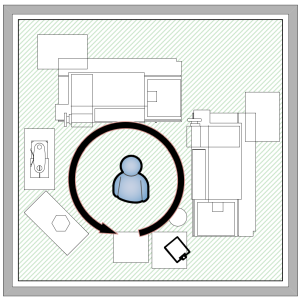
I’d wait by the machines until a pile of parts built up, then walk over to do the next operations. I was constantly trekking between the different work stations. It felt like it was too much effort and somehow still too slow.


So I asked if I could move a few things around for my shift.


The big CNCs couldn’t be moved, but they were already in an L-shape. I brought the other work benches in closer, roughly forming a circle in the order I needed them and all within easy reach. Eventually, I even brought the bin over too. Why keep walking across the factory just to throw away the planned waste, leaving the machines idle in the meantime as well as causing me extra effort.


That small shift changed everything.


The machines could do their part while I did mine.


It felt great. I was in a flow state and the process was flowing with me.


I’d take the parts as they came out of the machine and do everything I needed to smoothly, one task after another in order. All before the machine finished the next parts. The machines kept running because I had time to keep them fed. I could take more care over quality. I could spot and fix issues as they happened, instead of passing defects downstream.


Without knowing it, I’d just built my first cell layout, my first (near) one-piece flow, my first pull system, my first in line quality checks…and I felt good doing it.


I went home completely wiped out…but energised and fulfilled instead of frustrated and bored.


I’d made something better. I could see it. Feel it. Measure it.


Not just in the process, but in myself.


Sure, I got a few funny looks “What on earth’s going on over there?”


But I’d learned something important:


Changing the layout changed the work.

And changing the work changed me.


I didn’t know it then, but that was the start of my Lean journey.

Plan view of cell layout
Cell layout

The Real Reason Problems Stay Hidden

After visiting so many workplaces over the years, one pattern keeps showing up:

Most problems aren’t hidden by accident.

They’re hidden on purpose.

Not because people don’t care.

But because they don’t feel safe to say:

  • “This isn’t working.”
  • “That’s not safe.”
  • “We keep having the same problem.”
  • “I think there’s a better way.”


We often say, “Go to the gemba”, the place where the work is done, but what we do when we get there matters far more.

I’ve seen how one kind of question opens up conversation…
And another shuts it down completely.

I’ve seen how one leader builds trust…
While another, without realising, builds silence.

When someone points out a problem, is that treated as:

  • Causing trouble?
  • Or caring deeply?


In the best teams I’ve worked with, spotting problems is a respected act. It’s not a risk, or a blame game, it’s a sign of ownership and pride. It’s how they protect their customers, their colleagues, and their future, but none of that can happen unless people feel safe to speak up in the first place.

Psychological safety isn’t a luxury or a leadership trend. It’s a cultural requirement.

No safety = no learning.
No trust = no improvement.

One of the most important questions I ask leaders is this:

“What’s it like to tell the truth around here?”

Because if that feels risky, the problems aren’t the only thing being hidden.

Worth asking: What would happen if someone shared a tough truth in your workplace today?

Would they be encouraged and supported? Or would they quietly wish they hadn’t said anything at all?

Let’s build teams where truth isn’t risky, it’s rewarded.